

The POWER of Sanity-Checking your Exam Answers | Top 7 GCSE Maths Mistakes

Part 5 of 7 in our series "Top 7 Mistakes which GCSE Maths students make".
Invest three minutes of your time now to avoid heartbreak on Results Day!
For those of you in Year 11, or with children in that same year, you'll be acutely aware that GCSE exam season is little more than six weeks away now! The Easter holidays, during which you might have done lots of revision - or conversely, none at all (I won't tell if you don't) - are fast drawing to a close. This timely blog series by Gill Learning highlights seven common GCSE Maths mistakes and HOW to resolve them before the day of your exam rolls around! And whichever exam board your school or academic institution opts for, these common mistakes will apply to yours.
Today's advice essentially boils down to applying common sense and having a certain worldliness about you. I alluded to an example of failure to think sensibly and pragmatically on Thursday, when discussing the need to "understand your calculator" in Part three (kudos if you can go back and spot where). However, that was only one example of many. By exploring some further examples in greater depth, you're about to discover the power of sanity-checking your answers - something that you can apply to all of your GCSE Maths and Science exams.
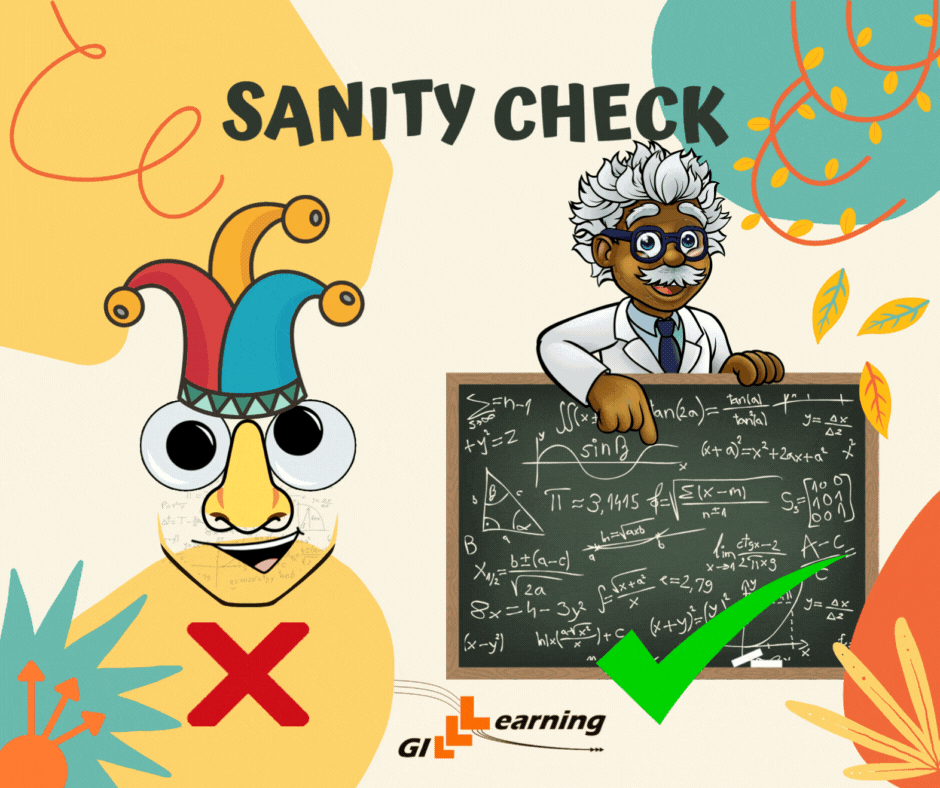
Sanity-checking your answers simply means not blindly writing down any old number in the answer box, even if it's clearly wrong. As a modern Physicist and practising Engineer, I'd call this an "order of magnitude" check; you might find "estimation" to be more familiar language, but we ultimately mean the same thing.
Take a classic example and you'll see what I mean: you're working out how long it takes Agatha to travel from Edinburgh to London on the train (no doubt she stops for a break midway through and gets on four different trains which each travel at a different speed). If you crunch the numbers and an answer of 34 minutes drops out from your workings, should you now confidently write 34 minutes into the answer box? Probably not - unless you're not bothered about getting all the marks!
The point is: you should imagine travelling from Edinburgh to London in real life (yes, the real world still exists within your Maths exam!). Perhaps even think about that before you attempt the question, to guesstimate approximately what your answer should be when you get there. You might not know the distance between those two capital cities; you might not know the average speed of a typical train. But you almost definitely know that London is in England, that Edinburgh is in Scotland, and that getting from one nation to the other is usually not a quick half-hour affair (unless you happen to live in Berwick-upon-Tweed).
So, now think again: does 34 minutes sound correct to you? No? Well, you'd be right. This "sanity-check" should serve as a prompt to check your workings, perhaps running through them again from scratch, or re-typing certain bits into the calculator. Ah, you found a mistake! Not to worry, it's easily done. 5 hours and 34 minutes, that sounds like a better answer now. Thank goodness that you applied some common sense…
Okay, internal monologues aside, the point remains that GCSE Maths exam questions don't exist in a completely different plane of existence to your daily life! Your answers should hold up to common sense scrutiny. Even on geometry diagrams which are "NOT drawn to scale", for example, an angle which is clearly visually acute should come out of your calculations as less than 90 degrees.
If you really want convincing, you should also know that questions whose answers don't stand up to this sort of common sense check are rejected by the exam board long before they make it into your exam booklet in May. The exam boards vet their draft exam papers with teams of dozens, and then vet them again, and again. That's why, unlike your typical secondary school textbook, there are never any mistakes, typos, or other nasties lurking in the final copies of the official exam papers each year.
Finally, remember that you can generalise this powerful principle. The journey-time example above focuses on the order of magnitude of numerical answers, however some GCSE Maths questions don't yield numerical answers at all! In those such cases, your sanity check should instead ensure that you've provided the right type of mathematical object: be that an equation, an expression, a set, a vector, a prime factorisation, a quadratic, and so on.
So, if you're asked to "write down an equation", then make sure that your final answer contains an equals sign! If not, you've probably written down an expression instead. If you're asked to "give your answer in the form [blah blah], where a and b are integers", then for goodness sake don't conclude with a = 1/2. And if you're asked "how many marbles are left over in the jar afterwards?", then do yourself a favour and avoid writing down -4, Pi, the square root of 2, or any other non-natural number. Sure, you'd probably make the examiner chuckle by playing "wrong answers only", but unfortunately you won't be awarded any marks for hilarity!
Please be sure to subscribe to our mailing list to be the first to know whenever new blogs, topic learning resources, or tutorial availability go live on the Gill Learning website. You can sign up at the bottom of this webpage. (Don't worry, we typically don't email our followers more than once or twice per month!)
Part six in our series covering the Top 7 GCSE Maths Mistakes will challenge your assumptions about the optimal order in which to tackle an exam, and debunk the myth that "front-to-back keeps you on-track". So I hope that you'll come back tomorrow for the penultimate entry in the series. Until then, do take care and enjoy your weekend!


Comments